Our Short List of 3

- Power: Internal rechargeable battery, runs continuously for up to 8 hours per the manufacturer
- Capacity: Up to 14 baseballs or 10 softballs
- Rhythm: One toss every 5 seconds
- Space needed: Works in a 10-by-10-foot area

- Power: Rechargeable battery
- Balls: Regulation baseballs, softballs, or dimpled balls
- Feed: Extendable ball stacker
- Adjustment: Height adjustable
- Power: 4 C batteries, not included
- Speeds: 10, 15 and 20 mph across 3 pitch speeds
- Angles: 3-angle pitch adjustment
- Balls: 4 foam balls included; ball feeder holds up to 9
All 3 Picks at a Glance
| Product | Specs | Action |
|---|---|---|
| 1. JUGS Toss Machine — best for serious solo practice |
| Check price on Amazon |
| 2. Furlihong 6902BHA — best rechargeable option for regulation balls |
| Check price on Amazon |
| 3. Franklin Sports MLB Power Pitcher — best first machine for young hitters |
| Check price on Amazon |
Key takeaways
- Compare the best battery operated pitching machines, from the rechargeable JUGS Toss and Furlihong 6902BHA to Franklin youth machines, with battery type, feed capacity and pitch speed for each.
As an Amazon Associate we earn from qualifying purchases.
The whole point of a pitching machine is repetition, and the whole point of a battery operated pitching machine is that those repetitions can happen where the practice actually is: a backyard with no outdoor socket, a park, a garage, or the far end of a field long after the extension leads have run out. Cordless machines trade raw top speed for freedom. The best of them are honest about that trade, feed balls at a steady rhythm a hitter can settle into, and run long enough on one charge or one set of batteries that the session ends because the hitter is done, not because the machine is.
This guide compares four battery powered machines that cover the realistic range of cordless practice: a rechargeable soft-toss machine built for serious solo work, a rechargeable toss machine that takes regulation balls, and two youth machines that run on ordinary household batteries. Every specification below is taken from the manufacturer’s or seller’s product page, and we have not personally tested these machines.
Affiliate Disclosure: This article contains affiliate links. If you buy through a link on this page, we may earn a commission at no extra cost to you.
Quick comparison
| Machine | Power | Balls | Rhythm and speed | Best for |
|---|---|---|---|---|
| JUGS Toss Machine | Internal rechargeable battery, up to 8 hours | Up to 14 baseballs or 10 softballs | One toss every 5 seconds | Solo soft-toss work in a small space |
| Furlihong 6902BHA | Rechargeable | Regulation baseballs, softballs or dimpled balls, extendable stacker | Height-adjustable toss | Players who want regulation balls without a cord |
| Franklin Sports MLB Power Pitcher | 4 C batteries | 4 foam balls included, feeder holds up to 9 | 10, 15 and 20 mph, 3 pitch angles | Young hitters learning timing |
| Franklin Sports MLB Pop Rocket | 4 AA batteries | 5 plastic balls included | Automatic release every 7 seconds | The youngest players, first machine |
What “battery operated” really covers
Cordless pitching machines fall into three groups, and confusing them is the main cause of disappointed buyers.
Rechargeable toss machines carry an internal battery and deliver a soft, looping toss rather than a fastball. They are training tools for hand-eye coordination and swing mechanics. Their great strength is rhythm: the same toss, at the same interval, hundreds of times in a session, which is exactly what groove-a-swing practice needs.
Battery powered youth machines run on disposable cells, usually C or AA batteries, and pitch lightweight foam or plastic balls at gentle speeds. They are toys in the best sense — safe, light, and simple enough for a child to set up — but they will not throw a regulation baseball and should never be bought expecting one to.
Full wheel machines with battery packs sit above this guide’s scope. The large one-wheel and two-wheel machines that throw regulation balls at game speed are mostly mains powered, with battery packs sold separately. If a listing in that class catches your eye, check whether the battery is included or an extra, and whether the quoted speeds apply to regulation balls or only to lightweight practice balls. The four machines below are all genuinely cordless as sold, with their power source stated plainly for each one.
The machines worth shortlisting
1. JUGS Toss Machine — best for serious solo practice
- Power: Internal rechargeable battery, runs continuously for up to 8 hours per the manufacturer
- Capacity: Up to 14 baseballs or 10 softballs
- Rhythm: One toss every 5 seconds
- Space needed: Works in a 10-by-10-foot area
JUGS is the name coaches reach for in this category, and the Toss Machine is the reason the brand appears in so many backyard recommendations. It is not a fastball machine. It tosses — a consistent, hittable soft toss delivered every five seconds — so a player working alone can take hundreds of swings in half an hour without a partner feeding balls or throwing their arm out. The internal rechargeable battery is the key specification: up to eight hours of continuous use means a full day of team practice, or a week of short solo sessions, between charges.
The small footprint matters as much as the battery. A machine that works in a ten-foot square works in a garage in winter and in the strip of yard most families actually have, paired with a net to stop the balls. It takes regulation baseballs and softballs rather than proprietary lightweight balls, so the contact feels real, though the manufacturer and experienced users both note it performs most consistently with the smooth practice balls it was designed around. Buy this if the goal is swing volume and timing work. Do not buy it to prepare for velocity — that is a different machine class entirely, and mostly a mains powered one.
2. Furlihong 6902BHA — best rechargeable option for regulation balls
- Power: Rechargeable battery
- Balls: Regulation baseballs, softballs, or dimpled balls
- Feed: Extendable ball stacker
- Adjustment: Height adjustable
The 6902BHA is Furlihong’s rechargeable toss machine, and its distinguishing feature is flexibility about what it throws. Regulation baseballs, softballs, and dimpled practice balls all work in the same machine, which makes it a sensible single purchase for a household with both a baseball player and a softball player, or for a coach who runs mixed sessions. The extendable ball stacker raises capacity beyond the base chute, so longer uninterrupted rounds are possible before someone has to reload.
Height adjustability is the other practical strength. A toss that arrives at the right height for a tall adult is wrong for a twelve-year-old, and a machine that can be set for both gets used by both. As a rechargeable design it shares the JUGS machine’s core advantage — set it up anywhere, run the session, charge it afterwards — while asking you to accept the same category limit: this is a toss machine for contact and coordination work, delivering balls to be hit rather than pitches to be timed at game speed. Check the current listing before ordering for exactly which balls and accessories are in the box, because bundles for this model vary.
3. Franklin Sports MLB Power Pitcher — best first machine for young hitters
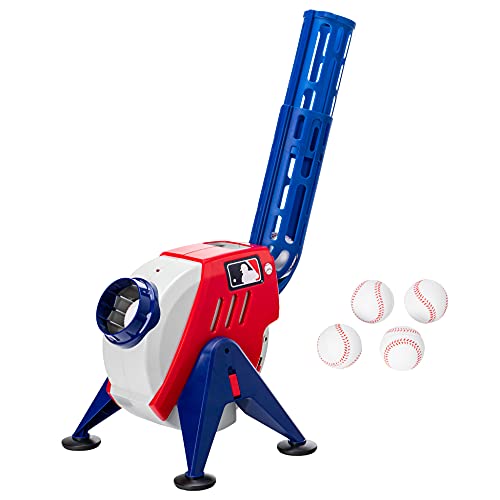
- Power: 4 C batteries, not included
- Speeds: 10, 15 and 20 mph across 3 pitch speeds
- Angles: 3-angle pitch adjustment
- Balls: 4 foam balls included; ball feeder holds up to 9
Franklin’s MLB Power Pitcher is the classic battery operated starter machine, and its specifications are well matched to its job. Three speeds topping out at a gentle 20 mph, foam balls that will not hurt a child or dent a fence, and a feeder that holds up to nine balls so a young hitter gets a real run of pitches instead of stopping after every swing. The three angle settings let a parent or coach vary the delivery a little as the hitter improves, and the flashing red release light is a genuinely useful teaching feature: it gives a nervous beginner a cue to start their load, which is the first timing skill worth learning.
The trade-offs are the honest ones for this class. It runs on four C batteries that are not in the box, so budget for rechargeable cells if it will be used weekly — a season of disposables adds up and performs worse as they fade. It throws only its foam balls; a regulation baseball would damage it and void any sympathy from the manufacturer. And at about four and a half pounds it is light enough to be knocked off line on uneven grass, so set it on a flat patch and check the aim after the first few pitches. Within those limits, it does exactly what a first machine should do.
4. Franklin Sports MLB Pop Rocket — simplest option for the youngest players
- Power: Battery powered, requires 4 AA batteries
- Balls: 5 plastic baseballs included
- Rhythm: Automatic ball release every 7 seconds
- Weight: Lightweight, at roughly two and a half pounds per the listing
The Pop Rocket strips the idea down to its minimum: load the plastic balls, switch it on, and a ball pops up every seven seconds for the hitter to swing at. There are no speeds to select and no angles to argue about, which for a five-to-eight-year-old is a feature, not a limitation — the session is about watching a moving ball and swinging at it, and the steady seven-second rhythm gives small hitters time to reset their feet and grip between swings.
AA batteries are the most convenient power source in this entire guide; every household already owns them or their rechargeable equivalents. The compromises are scale and ambition. Plastic balls in any breeze will wander, the machine is a starter toy rather than a training system, and a child who is already playing organised ball will outgrow it quickly — at which point the Power Pitcher above, or a toss machine, is the natural next step. As a first taste of machine-fed hitting, though, it is hard to beat for simplicity.
How to choose between them
Match the machine to the ball the hitter actually uses. If practice must feel like the real game, only the JUGS and the Furlihong take regulation balls. If the hitter is young enough that a real ball would be a safety problem, the foam and plastic ball Franklins are not lesser machines — they are the correct ones.
Count the true cost of the power source. A rechargeable machine costs its batteries once, in the purchase, and then asks only for charging discipline. A disposable-battery machine is cheaper to buy and more expensive to feed, and its performance sags as the cells tire. For weekly use, rechargeable cells in the youth machines close most of that gap.
Think about who is feeding and who is hitting. A toss machine’s value is that one person can practise alone. A youth pitching machine usually still needs an adult nearby to load, aim, and supervise. Buy the machine that fits the session you will actually run, not the one you imagine running.
Protect the space, not just the player. Even soft toss practice sends balls somewhere. A net behind the hitter, or a garage wall rated for the impact, turns every machine on this list into a better tool, because the hitter can swing freely instead of steering the ball away from windows.
Battery care for cordless machines
Rechargeable machines should be charged after use rather than stored flat, and topped up before a session rather than run to exhaustion mid-practice; a machine that dies halfway through a drill teaches the hitter nothing except frustration. For disposable-battery machines, remove the cells before long storage — leaked cells are the most common way these machines die in a cupboard — and keep a spare set with the machine so a flat set never cancels a session. Store every machine dry and indoors; the motors and feed mechanisms in this class are not weather sealed, whatever the backyard marketing implies.
Frequently asked questions
Can a battery operated pitching machine throw real baseballs at game speed?
Not in this class. The cordless machines that take regulation balls are toss machines, delivering the ball to be hit rather than pitching it at velocity. Game-speed wheel machines are predominantly mains powered, with separate battery packs available for some models at extra cost.
How long do the batteries last in practice?
The JUGS Toss Machine’s internal battery is rated by its manufacturer for up to eight hours of continuous use, which covers far more hitting than any single session needs. The youth machines’ runtime depends entirely on the cells fitted; fresh quality C or AA batteries cover many sessions of intermittent use, and rechargeable cells are the economical choice for regular play.
Are foam and plastic ball machines safe for children?
They are designed for it: the balls are soft or hollow, the speeds are low, and the Franklin machines above are aimed squarely at young beginners. Adult supervision is still required — a swung bat is the most dangerous object in any of these sessions — and eye protection is a sensible habit from the first day.
What should I check before ordering?
Confirm the power source and whether batteries are included, confirm which balls the machine accepts and whether they are in the box, and confirm the feed capacity if the hitter will practise alone. Those three checks prevent nearly every mismatch between what buyers expect and what arrives.
Verdict
For a player practising alone, the JUGS Toss Machine is the best battery operated pitching machine here: an eight-hour rechargeable battery, regulation balls, and a five-second rhythm built for hundreds of quality swings. The Furlihong 6902BHA is the flexible alternative, adding an extendable stacker and softball compatibility. For children, choose by age: the Franklin Power Pitcher for a young hitter ready for pitched foam balls at three speeds, and the Pop Rocket for the very youngest, where a simple pop-up every seven seconds is all the machine they need.