Our Short List of 3

All 3 Picks at a Glance
| Product | Specs | Action |
|---|---|---|
| 1. OPTIMA RedTop 34/78 — the starting specialist with two terminal styles | Check price on Amazon | |
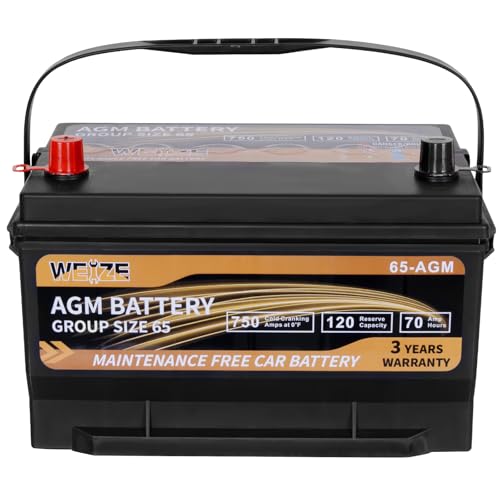 3. WEIZE Platinum AGM Group 65 — the big-case Ford fitment | Check price on Amazon | |
 4. OPTIMA RedTop 25 — the compact starting option | Check price on Amazon |
Key takeaways
- The best battery for a pickup truck depends on group size first. Compare four AGM picks — Optima RedTop, YellowTop and RedTop 25, plus a WEIZE Group 65 — by CCA and reserve.
There is no single battery that is right for every pickup truck, and any guide that pretends otherwise is skipping the step that actually decides your purchase: fitment. A pickup battery has to match your truck’s BCI group size, terminal layout and hold-down arrangement before its cranking figures mean anything at all. A battery with outstanding specifications that does not fit your tray, or whose terminals sit on the wrong side for your cables, is not a bargain — it is a return shipment.
With that rule stated, the shortlist below covers the group sizes and use patterns that dominate the pickup market. It includes a high-output starting battery with dual terminals that suits many trucks built for group 34 or 78, a dual-purpose battery for trucks that run winches and accessories, a compact starting battery in group 25, and a group 65 AGM built for the many full-size Fords and other trucks that specify that large case. Every figure cited comes from the manufacturer’s or the Amazon US listing details for that exact product. Nothing here is presented as the result of our own bench testing, and you should confirm group size, dimensions and current availability on the live product page and against your owner’s manual before ordering.
Affiliate Disclosure: This article contains affiliate links. If you buy through a link on this page, we may earn a commission at no extra cost to you. As an Amazon Associate we earn from qualifying purchases.
Quick comparison
| Pick | Group size | CCA | Reserve capacity | Best for |
|---|---|---|---|---|
| OPTIMA RedTop 34/78 | 34/78, dual terminals | 800 | 100 minutes | Strong starting, flexible fitment |
| OPTIMA YellowTop D34/78 | 34/78, dual terminals | 750 | 120 minutes | Winches, plows, big accessory loads |
| WEIZE Platinum AGM | 65 | 750 | 120 minutes | Trucks that specify Group 65 |
| OPTIMA RedTop 25 | 25 | 720 | 90 minutes | Compact trays calling for Group 25 |
Step one: find your truck’s group size
Before comparing brands, find the group size your truck already uses. The fastest sources are the label on your current battery, your owner’s manual, and the fitment guide for your exact year, cab, engine and trim. Group size is not a quality grade; it is a standardised case dimension and terminal arrangement. Common pickup fitments include group 65 in many Ford F-Series trucks of the 2004–2014 era and some later V8 builds, group 48 (H6) or 94R (H7) in many recent GM trucks, group 34 or 78 in a range of older GM and other applications, and group 24F or 27F in many Toyota trucks. Diesel pickups deserve extra care: many use two batteries, and a matched pair replaced together is the correct job, not a single new battery beside a tired one.
Cold cranking amps, the headline number on most listings, is the current a battery can deliver at 0°F for 30 seconds while holding voltage above a set threshold. More CCA than your truck requires does no harm, but it cannot rescue a battery of the wrong group size. Reserve capacity, stated in minutes, estimates how long the battery can run essential loads if the charging system fails; it matters more to trucks that idle with lights, radios and accessories working. Finally, check terminal position. A reversed terminal layout can leave your cables too short even when the case fits perfectly.
1. OPTIMA RedTop 34/78 — the starting specialist with two terminal styles
The RedTop 34/78 is OPTIMA’s starting battery in the dual-fitment 34/78 case, rated at 800 cold cranking amps with 100 minutes of reserve capacity and a 50 amp-hour C20 rating. Its listing dimensions are roughly 10.06 by 6.94 by 7.88 inches, and it carries both SAE top posts and GM-style side terminals in the same case. That dual-terminal design is its practical advantage in the pickup world, where it lets one battery serve trucks wired for either connection style within the 34/78 footprint.
OPTIMA builds the RedTop around its SpiralCell design, winding the plates into spiral cells with high-purity lead, a construction the company positions for strong cranking bursts and resistance to the vibration that trucks generate on rough roads and job sites. The case is sealed AGM, so it is maintenance-free and spill-proof in normal use, and it can be mounted more flexibly than a conventional flooded battery. OPTIMA describes the RedTop as a starting battery for vehicles with essentially stock electrical demands, and that honesty should guide your choice: this is the pick for a truck that needs to start hard and reliably, not the pick for one that spends its evenings winching or running a bank of accessories with the engine off.
Choose the RedTop 34/78 if your truck specifies group 34 or 78, you want the strongest starting figure in this shortlist, and your electrical loads are the ones the truck came with.
2. OPTIMA YellowTop D34/78 — for trucks that work their accessories
ASIN: B000MSBUA4
The YellowTop D34/78 occupies the same dual-terminal 34/78 footprint as the RedTop but is built as a dual-purpose battery: it is rated at 750 cold cranking amps, 55 amp-hours and 120 minutes of reserve capacity, and OPTIMA designs it to tolerate the deeper discharge cycles that accessory-heavy trucks impose. That difference in purpose matters more than the modest gap in cranking amps.
This is the battery in the list aimed at the way modified and working pickups are actually used. Winches, snowplow controls and lights, air compressors, upgraded audio, auxiliary lighting and repeated short-trip accessory use all draw a battery down in ways a pure starting battery is not built to repeat. A dual-purpose AGM accepts that cycling role while still starting the engine, which is why OPTIMA identifies this line for trucks with winches and high-demand electrical systems. It shares the sealed, maintenance-free AGM format and dual SAE and GM terminals of its RedTop sibling, at a listed weight of about 43.5 pounds.
Choose the YellowTop D34/78 if your truck’s battery dies from use rather than age — if accessories regularly run with the engine off, or your truck works a plow or winch through the season. If none of that describes your truck, the RedTop above is the more focused tool for the same tray.
3. WEIZE Platinum AGM Group 65 — the big-case Ford fitment
Group 65 is one of the classic full-size pickup sizes, standard on a long run of Ford F-150s and found across other Ford and Lincoln trucks and SUVs, and the WEIZE Platinum AGM is a direct entry in that size. Its listing rates it at 750 cold cranking amps, 70 amp-hours and 120 minutes of reserve capacity, in a case measuring about 12.05 by 7.56 by 7.56 inches, with tapered terminals arranged positive on the left and negative on the right. WEIZE backs the line with a 36-month warranty according to its listing.
The specification sheet is well matched to the job. Seventy amp-hours and 120 minutes of reserve give a working truck a sensible buffer for accessory loads and charging-system hiccups, and 750 CCA is a solid starting figure for the large petrol V8s most Group 65 trucks carry. WEIZE also makes a point worth repeating from its own listing guidance: if your truck originally came with an AGM battery, replace it with an AGM rather than downgrading to a flooded battery, because the charging behaviour and the fitment assumptions of the truck were built around the original type.
The cautions are fitment cautions, as they should be. Group 65 does not fit most newer trucks that moved to smaller or different cases, so confirm your truck actually specifies 65, measure the tray, and check that the left-positive terminal layout matches your cables before ordering.
Choose the WEIZE Platinum Group 65 if your truck’s manual or existing battery says Group 65 and you want an AGM in the correct large case with a long reserve figure.
4. OPTIMA RedTop 25 — the compact starting option
Not every pickup takes a large battery. Compact and older trucks, and some import pickups, specify group 25, and the RedTop 25 brings OPTIMA’s starting-battery formula to that smaller case: 720 cold cranking amps and 90 minutes of reserve capacity in a sealed AGM design intended for vehicles with basic electrical demands.
The reasoning mirrors the 34/78 RedTop in a smaller footprint. SpiralCell construction, strong cranking output for its size, and a sealed maintenance-free case suit a truck that lives outdoors, works on unmade roads, or simply needs dependable starts without accessory theatrics. Its lower reserve capacity compared with the bigger picks here is the honest trade-off of the smaller case, and it is the right trade for a truck whose tray will not accept anything larger.
Choose the RedTop 25 if group 25 is what your truck specifies and starting reliability, rather than accessory endurance, is your priority.
AGM or flooded: which should a pickup use?
Most of the modern pickup parc was designed around one of two lead-acid families. Conventional flooded batteries remain the basic option: they work, and they are what many trucks left the factory with. AGM batteries, including every pick in this guide, suspend the electrolyte in glass mat, which makes them sealed, spill-resistant, more tolerant of vibration, and generally better at accepting charge and handling accessory loads. Trucks that came with AGM from the factory — increasingly common on models with stop-start systems — should stay with AGM, as WEIZE’s own listing guidance notes. Trucks that came with a flooded battery can usually upgrade to the same group size in AGM, and for a truck that tows, works off-road or runs accessories, that upgrade is often the most sensible money in the whole purchase.
What AGM does not forgive is chronic undercharging. Repeated short trips that never refill the battery, or a failing alternator, will shorten any battery’s life. If your truck kills batteries quickly, test the charging system before blaming the replacement.
Fitting and looking after a truck battery
Fitment checks take five minutes and prevent most returns. Confirm the group size, then measure the tray and compare it with the listing dimensions. Confirm which side the positive terminal sits on, and that your cables will reach without strain. Confirm the hold-down style, because a battery that can shift under the clamp will not survive truck duty for long, whatever its cranking figure.
After fitting, look after the basics. Keep terminals clean and tight, since a loose or corroded connection imitates a dead battery perfectly. If the truck sits for weeks between uses — common for farm, site and second trucks — a maintainer charger suited to AGM batteries is cheap insurance against the deep discharge that shortens battery life more than almost anything else. And when a diesel’s paired batteries reach the end, replace both together: a new battery paired with a weak one is dragged down to the weaker unit’s level.
Frequently asked questions
What group size does my pickup truck need?
It depends on the truck, not on preference. Check the label on your current battery or the owner’s manual for your exact year and engine. Group 65, 48 (H6), 94R (H7), 34/78, 24F and 25 all appear across the pickup parc, and they are not interchangeable.
How many cold cranking amps does a pickup need?
At least what the manufacturer specifies for your engine, and more is useful in cold climates and on large or diesel engines. The picks in this guide range from 720 to 800 CCA, all comfortably in working-truck territory for the fitments they serve.
Is an AGM battery worth it in a truck?
For trucks that came with AGM, it is not optional in practice — replace like with like. For other trucks, AGM earns its keep through vibration resistance, sealed construction and better handling of accessory loads, all common in pickup use.
My truck has two batteries. Can I replace just one?
You can, but you should not plan to. In a paired diesel setup the batteries share the work and age together; fitting one new battery beside a worn one shortens the new battery’s life. Replace the pair.
Why does terminal position matter so much?
Because truck battery cables are made to a fixed length for a fixed layout. A battery with the positive terminal on the opposite side can leave the cable physically unable to reach, even when the case fits the tray exactly. Check polarity layout against your old battery before ordering, as the WEIZE Group 65 listing itself advises.
The bottom line
Buy the group size first and the brand second. For trucks on the 34/78 fitment, the OPTIMA RedTop 34/78 (B00075OSC4) is the starting specialist, and the OPTIMA YellowTop D34/78 (B000MSBUA4) is its dual-purpose counterpart for accessory-heavy work. For the long run of Group 65 trucks, the WEIZE Platinum AGM (B0G5115BXS) matches the big case with 750 CCA and a long reserve. For compact group 25 trays, the OPTIMA RedTop 25 (B000MSBU9U) keeps the same starting-first formula in a smaller case. Confirm your fitment on the live listing and in your manual, and any of these four will do the job your truck actually asks of it.