Our Short List of 3

- Best for: First-time riders aged 2-5 who need maximum stability while learning balance.
- Age range: 2-5 years
- Weight limit: 110 lbs (spec table; older description copy mentions 75 lbs — verify live)
- Wheels: 3 solid polyurethane wheels, 120 mm
- Handlebar: adjustable T-bar, 17 inches (49-68 cm)
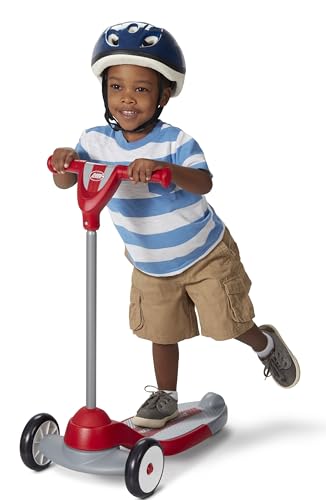
- Best for: The very first scooter for a 2-3-year-old — the widest, lowest, simplest starter in the pool.
- Age range: 2-5 years (24 months to 5 years)
- Weight limit: 50 lbs
- Wheels: 3 wheels (wheel size not stated — Amazon listings conflict)
- Handlebar: fixed, 24.21 inches (pink variant lists adjustable — verify live)

- Best for: The youngest first riders (age 3+) on a tight budget — the cheapest name-brand 3-wheeler in the pool.
- Age range: ages 3+
- Weight limit: 44 lbs (title; spec table lists 45 lbs — verify live)
- Wheels: 3 polyurethane wheels (size not stated — Amazon listings report impossible sizes)
- Handlebar: fixed T-bar per the spec table (some listings say adjustable — verify live)
All 5 Picks at a Glance
| Product | Specs | Action |
|---|---|---|
| Micro Kickboard Mini Deluxe |
| Check price on Amazon |
| Radio Flyer My 1st Scooter |
| Check price on Amazon |
| Razor Jr. Lil’ Kick |
| Check price on Amazon |
 Hurtle ScootKid |
| Check price on Amazon |
 Razor A Kick Scooter |
| Check price on Amazon |
Key takeaways
- Find the best kids scooters for beginners, from stable 3-wheel lean-to-steer first scooters to a 2-wheel graduate pick for confident 5-year-olds.
The best kids scooter for a beginner is a three-wheel lean-to-steer model, and the Micro Kickboard Mini Deluxe is the strongest all-round pick for ages 2 to 5. For the very youngest riders, the Radio Flyer My 1st Scooter is the simplest first scooter, while the Hurtle ScootKid adds a seat for toddlers who are not ready to stand. Once a child can balance confidently, usually around age five, the two-wheel Razor A is the right next step.
This guide is for parents buying a first scooter for a toddler or preschooler, and for parents of a five-year-old who has outgrown three wheels and needs a two-wheel scooter. Every scooter below is a non-electric kick scooter chosen from its Amazon listing title and specifications, so the age ranges, weight limits, and handlebar heights come from the product pages themselves. Where Amazon’s own listing contradicts itself, the article says so instead of picking the friendlier number.
Quick Picks
As an Amazon Associate we earn from qualifying purchases
| Product | Best for | Key spec from title |
|---|---|---|
| Micro Kickboard Mini Deluxe | First scooter for ages 2-5 | 3-wheel lean-to-steer, ages 2-5, up to 110 lbs |
| Radio Flyer My 1st Scooter | Very first scooter for a 2-3-year-old | 3-wheel, ages 2-5, extra-wide base |
| Razor Jr. Lil’ Kick | Budget first scooter for ages 3+ | 3-wheel, ages 3+, max rider weight 44 lb |
| Hurtle ScootKid | Toddler not ready to stand | 2-in-1 sit-or-stand, ages 1 and up, flip-out seat |
| Razor A Kick Scooter | Graduate pick for confident 5+ riders | 2-wheel, ages 5+, foldable aluminum frame |
How to Choose
Start with three wheels, move to two later
A three-wheel scooter stands upright on its own, so a beginner can climb on, push, and stop without holding the scooter up at the same time. That stability is the whole point of a first scooter: the child learns to push, steer, and brake while the scooter does the balancing. Two-wheel scooters demand the opposite — the rider holds the scooter upright, which is why they suit children who already balance well, usually from age five. Buying a two-wheeler first usually means more falls and a scooter that sits unused. Let the child master three wheels first, then graduate.
Read the age range and the weight limit together
Every scooter in this guide lists both an age range and a weight limit, and the two numbers rarely agree — so always check which one binds first. The Micro Mini Deluxe is rated ages 2 to 5 with a 110 lb limit, which means age and height bind long before weight does. The Radio Flyer is also rated 2 to 5, but its 50 lb limit binds first: many children reach 50 lb before their fifth birthday. The Hurtle claims ages up to 14, yet its seated limit is only 45 lb, so treat it as a toddler scooter whatever the title says. Compare both figures, and size for the one your child will hit first.
Adjustable bars give growing room; fixed bars do not
A handlebar that adjusts lets one scooter last through two or three growth spurts, while a fixed bar fits only the height it was built for. The Micro Mini Deluxe and the Hurtle both adjust — the Hurtle through four heights from 25.5 to 34 inches — so a child who grows fast keeps using the same scooter. The Radio Flyer, by contrast, has a fixed bar at about 24 inches, which is fine for a small two-year-old but leaves no room for a tall four-year-old. Before buying, measure the bar against your child’s waist or hip height: the grips should sit near the waist, not at the chest or the knees.
Deck height, deck width, and the scooter’s own weight
A low, wide deck matters more than any other feature on a first scooter. A deck that sits close to the ground lets a small child step on without lifting a foot high, and a wide deck fits both feet when the child wants to coast. The Radio Flyer and the Razor Jr. both use extra-wide, low decks for exactly this reason. Weight matters too: the Hurtle weighs up to 9 lb, more than twice the Micro at 4.2 lb, and a toddler cannot carry a heavy scooter up steps or into the car. Check the deck height and the scooter’s weight together — a light, low scooter gets ridden far more than a heavy, tall one.
The 5 Best Options
Micro Kickboard Mini Deluxe
- Best for: First-time riders aged 2-5 who need maximum stability while learning balance.
- Age range: 2-5 years
- Weight limit: 110 lbs (spec table; older description copy mentions 75 lbs — verify live)
- Wheels: 3 solid polyurethane wheels, 120 mm
- Handlebar: adjustable T-bar, 17 inches (49-68 cm)
First-time riders aged 2-5 who need maximum stability while learning balance.
Amazon’s own copy conflicts on the weight limit (75 vs 110 lbs) — check live availability and the current limit before ordering.
The Micro Kickboard Mini Deluxe is the benchmark first scooter for a reason: three wide-set wheels, a low grippy deck, and lean-to-steer handling that teaches balance gently instead of punishing wobbles. The adjustable T-bar grows with the child from age two to five, and the scooter weighs only 4.2 lb, so a preschooler can pick it up and carry it. Replacement parts and a two-year warranty mean a scooter that survives being passed down to a younger sibling. Its age range, not its generous 110 lb weight limit, is what binds — most children outgrow it by height around age five.
Watch out for: Amazon’s own copy conflicts on the weight limit (75 vs 110 lbs) — check live availability and the current limit before ordering.
Radio Flyer My 1st Scooter
- Best for: The very first scooter for a 2-3-year-old — the widest, lowest, simplest starter in the pool.
- Age range: 2-5 years (24 months to 5 years)
- Weight limit: 50 lbs
- Wheels: 3 wheels (wheel size not stated — Amazon listings conflict)
- Handlebar: fixed, 24.21 inches (pink variant lists adjustable — verify live)
The very first scooter for a 2-3-year-old — the widest, lowest, simplest starter in the pool.
The 50 lb limit is the second-lowest in the pool, and the fixed bar has no growing room — check live availability before ordering.
The Radio Flyer My 1st Scooter is the simplest first scooter in this guide, built for the very youngest riders. Its extra-wide base and low frame make it the easiest scooter here to step onto, and the fixed handlebar means there is nothing to adjust, loosen, or set wrong. It is sold directly by Amazon, which is the strongest stock signal in this pool. The trade-off is growing room: the 50 lb weight limit binds before the age range does, and the fixed bar cannot grow with a tall child. For a two- or three-year-old’s first scooter, though, that simplicity is exactly the point.
Watch out for: The 50 lb limit is the second-lowest in the pool, and the fixed bar has no growing room — check live availability before ordering.
Razor Jr. Lil’ Kick
- Best for: The youngest first riders (age 3+) on a tight budget — the cheapest name-brand 3-wheeler in the pool.
- Age range: ages 3+
- Weight limit: 44 lbs (title; spec table lists 45 lbs — verify live)
- Wheels: 3 polyurethane wheels (size not stated — Amazon listings report impossible sizes)
- Handlebar: fixed T-bar per the spec table (some listings say adjustable — verify live)
The youngest first riders (age 3+) on a tight budget — the cheapest name-brand 3-wheeler in the pool.
Amazon’s fields contradict each other on the handlebar, brake, and wheel size, and a sibling listing showed no featured offers — check live availability before ordering.
The Razor Jr. Lil’ Kick is the budget pick: a three-wheel scooter with an extra-wide, slip-resistant deck and a low profile that makes it forgiving for a three-year-old’s first rides. The welded steel frame is sturdy, and at 5.2 lb it is light enough for a small child to handle. It is also the most conflicted listing here — Amazon’s fields disagree on whether the handlebar adjusts, whether it has a brake, and on the wheel size — so treat every specification except the age range as unconfirmed. The 44 lb weight limit is the lowest in the pool, which means bigger four- and five-year-olds outgrow it fast.
Watch out for: Amazon’s fields contradict each other on the handlebar, brake, and wheel size, and a sibling listing showed no featured offers — check live availability before ordering.
Hurtle ScootKid
- Best for: The youngest riders (ages 1-3) who are not ready to stand — start seated, remove the seat when ready to scoot standing up.
- Age range: 1 year old and up
- Weight limit: 132 lbs standing; 45 lbs when seated
- Wheels: 3 polyurethane wheels, 120 mm front / 80 mm rear; LED flashing wheels
- Handlebar: adjustable, 4 heights — 25.5 / 27.5 / 31 / 34 inches
The youngest riders (ages 1-3) who are not ready to stand — start seated, remove the seat when ready to scoot standing up.
The seat makes this a different type from a plain kick scooter, and Amazon crawls conflict on stock — check live availability before ordering.
The Hurtle ScootKid is the only scooter here with a seat, and that makes it the bridge for toddlers who are not ready to stand. A flip-out seat lets a one- or two-year-old ride sitting down, then folds away when the child is ready to scoot standing up. The handlebar adjusts through four heights, from 25.5 to 34 inches, and the wheels flash as they roll. It is the heaviest scooter in the pool at up to 9 lb, so a small child cannot carry it far. Both limits matter: 132 lb standing, but only 45 lb seated.
Watch out for: The seat makes this a different type from a plain kick scooter, and Amazon crawls conflict on stock — check live availability before ordering.
Razor A Kick Scooter
- Best for: Confident 5+ riders graduating from a 3-wheel scooter — the lightest 2-wheel starter, foldable for the car or school run.
- Age range: ages 5+
- Weight limit: 143 lbs
- Wheels: 2 polyurethane wheels, 98 mm
- Handlebar: adjustable, 23.6 inches; foam grips
Confident 5+ riders graduating from a 3-wheel scooter — the lightest 2-wheel starter, foldable for the car or school run.
Two wheels means no self-standing stability — a child who has never scooted will fall more; check live availability before ordering.
The Razor A is the only two-wheel scooter in this guide, and it belongs at the end of the list for a reason: it is the next step, not the first step. At 4.6 lb with a foldable aluminum frame, it is light and easy to carry. The 98 mm polyurethane wheels and rear-fender brake suit a child who already balances and steers confidently. Do not buy it for a child who has never scooted — without a third wheel there is nothing holding the scooter upright, and the falls come faster. For a confident five-year-old graduating from three wheels, it is the natural next scooter.
Watch out for: Two wheels means no self-standing stability — a child who has never scooted will fall more; check live availability before ordering.
Which One Fits Your Situation
First scooter for a 2-year-old
Buy the Radio Flyer My 1st Scooter. Its extra-wide, low base is the easiest to step onto, the fixed handlebar means nothing to set wrong, and it is sold directly by Amazon. The 50 lb limit means it will be outgrown, but for a two-year-old’s first year of scooting, simplicity beats growing room.
A 3- or 4-year-old learning balance
Buy the Micro Kickboard Mini Deluxe. The lean-to-steer design teaches balance gently, the adjustable bar grows with the child through age five, and at 4.2 lb the scooter is light enough to carry. It is the benchmark three-wheeler for this age, and replacement parts keep it going for a younger sibling.
A toddler who is not ready to stand
Buy the Hurtle ScootKid. The flip-out seat lets a one- or two-year-old ride sitting down, then folds away when standing feels safe. Four handlebar heights give it growing room no other toddler scooter here offers. Remember the seated limit is only 45 lb, and check stock live first before ordering.
A 5-year-old graduating to two wheels
Buy the Razor A Kick Scooter. It is the only two-wheeler in this guide, and it suits a child who already balances and steers well on three wheels. The foldable frame and 4.6 lb weight make it easy to carry, and the adjustable bar fits a growing rider. Never buy it as a first scooter.
Common Mistakes
- Buying a two-wheel scooter as a first scooter — a beginner needs three wheels for stability, and two wheels mean more falls.
- Trusting the age range alone — always check the weight limit too, since the Radio Flyer’s 50 lb limit binds before its age range does.
- Expecting the bars to turn — all four three-wheelers here steer by leaning, so a child who twists the bars will think the scooter is broken.
- Quoting the Hurtle’s 132 lb limit without the 45 lb seated limit — the seated figure is the one that matters for a toddler.
- Ordering without a live stock check — Amazon listings in this category conflict on specs and availability, so confirm before ordering.
Frequently Asked Questions
What age should a child start on a scooter?
Most children are ready for a three-wheel scooter between ages two and three, once they can walk steadily and push with one foot. The Hurtle ScootKid suits riders from age one with its seat, while the Radio Flyer and Micro Mini Deluxe are built for ages two to five. Start on flat, smooth ground away from traffic.
Should a beginner use a 3-wheel or 2-wheel scooter?
A beginner should always start on three wheels. A three-wheel scooter stands on its own, so the child learns to push, steer, and brake while the scooter handles the balancing. A two-wheel scooter suits children from around age five who already balance confidently. Starting on two wheels usually means more falls and a scooter that gets abandoned.
How do lean-to-steer scooters work?
The child steers by leaning their body to one side, and the scooter’s front wheels tilt in that direction. The handlebar does not turn left and right the way a bicycle’s does — it stays fixed while the deck leans. This feels strange on the first rides, so expect a short learning curve before it clicks.
When is a child ready for a 2-wheel scooter?
A child is ready when they can balance, steer, and stop confidently on a three-wheel scooter without wobbling or putting a foot down constantly. Most children reach that point around age five, which is why the Razor A is rated ages five and up. If the child still wobbles on three wheels, wait — there is no rush to graduate.