Our Short List of 3
All 5 Picks at a Glance
| Product | Specs | Action |
|---|---|---|
 1. iQcrew IN50C-PB10 Inverted Microscope Kit | Check price on Amazon | |
 2. AmScope IN200TB-5MA Digital Inverted Microscope | Check price on Amazon | |
 3. AmScope IN300TC-5MA Digital Inverted Microscope | Check price on Amazon | |
 4. AmScope IN300TC-8M-R Digital Inverted Microscope | Check price on Amazon | |
 5. AmScope IN480TA-5M Digital Inverted Microscope | Check price on Amazon |
Key takeaways
- Best inverted biological microscopes for student lab projects: five inverted microscopes for cultures and well plates, from a student kit to lab models.
Disclosure: As an Amazon Associate, this site may earn from qualifying purchases made through links on this page.
Intro
An inverted biological microscope turns the usual microscope upside down: the objectives sit below the stage, and the light comes from above. That layout exists for one reason. It lets you look at living cultures, well plates, petri dishes, and flasks from underneath, without lifting the lid or disturbing the sample. For a student lab project, that is the difference between watching cells grow in their own vessel and moving the sample to a glass slide every time you want a look.
The five microscopes in this guide are all inverted biological compound microscopes, and all five are sold as complete instruments with a camera or a camera port. They range from a student kit that ships with prepared slides and an experiment guide, to lab-grade digital models with 5MP and 8MP cameras, long working distance objectives, and mechanical stages. The right pick depends on the project: a classroom project needs a simple kit, a cell culture project needs a long working distance and a camera, and a project that ends in a report needs images worth putting in it.
One framing point matters before the picks. An inverted microscope is built for vessels, cultures, and live samples in liquid. Prepared slides can still be observed on an inverted microscope, and the student kit below ships with prepared slides, but the upright compound microscope is the direct tool for slide work. If your project is mostly prepared slides on glass, an upright compound microscope will serve you better. If your project watches cultures grow in dishes and plates, an inverted microscope is the right instrument, and the picks below are the ones to compare.
At a Glance
| Pick | Microscope | Why it stands out |
|---|---|---|
| 1 | iQcrew IN50C-PB10 student kit | The student pick, with prepared slides and an experiment guide |
| 2 | AmScope IN200TB-5MA | The entry digital pick, 40X-800X with a 5MP camera |
| 3 | AmScope IN300TC-5MA | The lab-grade digital pick, 40X-1000X with a 5MP camera |
| 4 | AmScope IN300TC-8M-R | The highest-resolution camera in the group, 8MP |
| 5 | AmScope IN480TA-5M | The plan-objective pick, 40X-900X with infinity optics |
How to Choose
Start with the sample, not the magnification. An inverted microscope holds its place when the sample lives in a vessel: a petri dish, a multi-well plate, a flask, or a vial. The objectives look up through the bottom of the vessel, so the sample stays where it is. If your project grows cultures, counts cells in a dish, or watches a sample change over days, the inverted layout is the point. If your project is a set of prepared slides, read the framing note above and consider an upright compound microscope instead.
Match the magnification range to the project. The picks here run from 40X to 500X at the student end and 40X to 1000X at the lab end. A student project that looks at cells in a dish will spend most of its time at the low end, around 40X to 100X, where the whole field is visible. Higher magnification is for detail work on individual cells, and it needs a steady stage and good light. Do not buy magnification you will not use; buy the range that matches the work.
Understand long working distance. Long working distance means the objective sits further from the sample, which leaves room for a thick dish, a tall flask, or a multi-well plate between the lens and the stage. All four AmScope picks in this guide use long working distance objectives. The student kit uses a shorter working distance, which is fine for the slides and thin vessels it ships with, but it will not fit the same range of lab vessels.
Decide whether the camera matters. A digital microscope with a USB camera lets you capture images and video for a lab report, and all four AmScope picks include a camera or a camera port. The cameras here are 5MP on three models and 8MP on one, and all four include a 0.5X reduction lens on the models that name it, which widens the field of view on the screen. If your project ends in a report with images, the camera is not an extra; it is the point of the instrument. If you only need to look, the student kit’s eyepieces are enough.
Check the stage. A mechanical stage moves the sample in small, controlled steps across X and Y, which matters when you are counting cells or scanning a well plate. The digital AmScope models in this guide include a mechanical stage. The student kit uses a simpler stage, which is fine for a first project but slower for systematic scanning.
Plan the light. The light source on these models is halogen, LED, or both, depending on the model. Halogen gives a warm, bright light; LED runs cooler and lasts longer. For live cultures, a cooler light is kinder to the sample over a long session, so note the light source when you compare two models that otherwise look alike.
Think about the bench. An inverted microscope is a heavy, wide instrument, and the lab-grade models need a steady bench with room for the stage, the camera cable, and a laptop. The student kit is smaller and lighter. Measure the bench before ordering, and check the weight on the listing: the IN480TA-5M lists 3.3 pounds for the instrument itself, which is light for its class, while the larger IN300 models are heavier bench instruments.
The Picks
1. iQcrew IN50C-PB10 Inverted Microscope Kit
The iQcrew IN50C-PB10 is the student pick in this guide, and it is the only one that ships as a kit with an experiment guide, blank slides, and prepared slides. The magnification runs 40X to 500X, which covers the range a student project needs for cells, tissues, and small organisms in a dish. The kit is built for a student bench: it is simpler than the lab-grade models, it sets up quickly, and it comes with the slides a first project needs.
The listing names the model IN50C-PB10, from the iQcrew brand, with a 5-year warranty. The microscope is an inverted student microscope, so the objectives sit below the stage and the sample sits in a vessel above. For a student lab project, that layout is the lesson itself: the sample stays in its own container while you look at it.
Choose this pick if the project is a first microscope, a classroom assignment, or a science fair entry. It is the least expensive way into the inverted layout, and the included slides and experiment guide mean the project can start the day the box arrives. If the project needs a camera, a mechanical stage, or magnification past 500X, look at the AmScope models below.
Key details: 40X-500X magnification; inverted student microscope kit with experiment guide, blank slides, and prepared slides; 5-year warranty; model IN50C-PB10.
iQcrew IN50C-PB10 Inverted Microscope Kit
2. AmScope IN200TB-5MA Digital Inverted Microscope
The AmScope IN200TB-5MA is the entry digital pick, and it is the step up from the student kit for a project that needs images. The magnification runs 40X to 800X, with long working distance plan objectives, and the included 5MP CMOS camera connects over USB 2.0, with a 0.5X reduction lens that widens the field of view on screen. The light source is halogen, and the stage is mechanical.
The listing names the model IN200TB-5MA, from AmScope, with a trinocular head. One detail on the listing deserves a note: the specification table describes the head as a Siedentopf binocular head, while the title names the instrument as trinocular. The instrument has a camera port alongside the viewing head, which is what the digital setup needs, so read the listing for the camera arrangement before ordering.
Choose this pick if the project needs a camera and a mechanical stage, but the budget does not stretch to the IN300 models. It covers tissue culture observation and well plate work at 40X to 800X, which is the range most student cell culture projects live in.
Key details: 40X-800X magnification; 5MP CMOS camera with USB 2.0 and 0.5X reduction lens; long working distance plan objectives; mechanical stage; halogen light; model IN200TB-5MA.
AmScope IN200TB-5MA Digital Inverted Microscope
3. AmScope IN300TC-5MA Digital Inverted Microscope
The AmScope IN300TC-5MA is the lab-grade digital pick, and it is the model to choose when the project needs the full 40X to 1000X range. The 5MP CMOS camera connects over USB 2.0, with a 0.5X reduction lens included, and the light source is halogen and LED. The objectives are long working distance, and the stage is mechanical, so the instrument handles dishes, multi-well plates, and flasks without moving the sample.
The listing names the model IN300TC-5MA, from AmScope, and the title describes it as a digital long working distance inverted trinocular microscope. The 1000X top end comes from the 40X objective with the higher-power eyepieces, and the plan optics keep the field sharp edge to edge at the magnifications a student project uses most.
Choose this pick if the project is a serious cell culture project, a multi-week observation, or a report that needs high-magnification images. It is the most capable digital microscope in this guide at the 5MP level, and it is the model that a lab course would put on the bench.
Key details: 40X-1000X magnification; 5MP CMOS camera with USB 2.0 and 0.5X reduction lens; long working distance objectives; mechanical stage; halogen and LED light; model IN300TC-5MA.
AmScope IN300TC-5MA Digital Inverted Microscope
4. AmScope IN300TC-8M-R Digital Inverted Microscope
The AmScope IN300TC-8M-R is the highest-resolution camera pick in the group, with an 8MP CMOS sensor where the other digital models use 5MP. The magnification runs 40X to 1000X, with long working distance plan optics and a halogen light source. The extra pixels matter when the project needs a large image for a poster or a report, or when a small detail has to survive being enlarged on screen.
The listing names the model IN300TC-8M-R, from AmScope, and the model number on the listing reads IN300TC-8M. The instrument is the same IN300TC body as the 5MA pick above, with the 8MP camera in place of the 5MP camera, so the choice between the two is a camera choice, not a microscope choice. If the project needs the sharpest images in the group, this is the pick. If 5MP is enough for the report, the 5MA saves the difference.
Key details: 40X-1000X magnification; 8MP CMOS camera with USB 2.0; long working distance plan optics; halogen light; model IN300TC-8M-R.
AmScope IN300TC-8M-R Digital Inverted Microscope
5. AmScope IN480TA-5M Digital Inverted Microscope
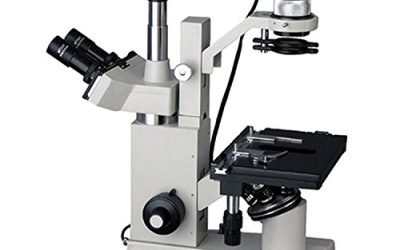
The AmScope IN480TA-5M is the plan-objective pick, and it is here for the optics. The objectives are plan, infinity-corrected, long working distance achromatic lenses in 4X, 10X, 20X, 40X, and 60X, which gives a flat, sharp field across the whole view. The magnification runs 40X to 900X, with a 5MP CMOS camera over USB 2.0 and a 0.5X reduction lens included, and the light source is halogen and LED.
The listing names the model IN480TA-5M, from AmScope, and lists the instrument weight at 3.3 pounds, which is light for a digital inverted microscope and useful if the instrument moves between benches or between a classroom and a home bench. The 60X objective is the detail that sets this model apart: it gives a high-magnification option without going to the 1000X top end of the IN300 models.
Choose this pick if the project values a flat, sharp field and a lighter instrument, or if the 60X objective matches the work better than a 1000X top end. It is the optics-first pick in the group.
Key details: 40X-900X magnification; plan infinity long working distance objectives 4X, 10X, 20X, 40X, 60X; 5MP CMOS camera with USB 2.0 and 0.5X reduction lens; halogen and LED light; 3.3 pounds; model IN480TA-5M.
AmScope IN480TA-5M Digital Inverted Microscope
Comparison Table
| Microscope | Magnification | Camera | Objectives | Light | Stage | Best for |
|---|---|---|---|---|---|---|
| iQcrew IN50C-PB10 | 40X-500X | None (eyepieces) | Student set | Halogen | Simple | First project, classroom |
| AmScope IN200TB-5MA | 40X-800X | 5MP CMOS, USB 2.0 | Long working distance plan | Halogen | Mechanical | Entry digital, culture work |
| AmScope IN300TC-5MA | 40X-1000X | 5MP CMOS, USB 2.0 | Long working distance | Halogen + LED | Mechanical | Lab-grade digital |
| AmScope IN300TC-8M-R | 40X-1000X | 8MP CMOS, USB 2.0 | Long working distance plan | Halogen | Mechanical | Sharpest images |
| AmScope IN480TA-5M | 40X-900X | 5MP CMOS, USB 2.0 | Plan infinity LWD 4X-60X | Halogen + LED | Mechanical | Flat field, light bench |
Which One Fits Your Situation
If this is a first microscope for a student project: the iQcrew IN50C-PB10 kit. It ships with prepared slides, blank slides, and an experiment guide, and its 40X to 500X range covers what a first project needs. It is the only pick here that is a kit rather than a bench instrument.
If the project needs a camera and a mechanical stage: the AmScope IN200TB-5MA. It is the entry digital model, with a 5MP camera, a 0.5X reduction lens, and 40X to 800X magnification, which covers most student cell culture work.
If the project is a serious lab course assignment: the AmScope IN300TC-5MA. The 40X to 1000X range, the 5MP camera, and the mechanical stage are the lab-grade combination, and it is the model a course would put on the bench.
If the report needs the sharpest images: the AmScope IN300TC-8M-R. The 8MP camera is the highest resolution in the group, and the instrument is otherwise the same IN300TC body as the 5MA, so the choice is about the camera.
If the project values optics and a lighter bench: the AmScope IN480TA-5M. The plan infinity objectives give a flat field, the 60X objective adds a high-magnification option, and the 3.3-pound instrument moves easily between benches.
FAQ
What is the difference between an inverted microscope and a normal microscope?
In a normal, upright microscope, the objectives sit above the stage and look down at a slide. In an inverted microscope, the objectives sit below the stage and look up through the bottom of a dish, plate, or flask. The inverted layout lets you observe a sample in its own vessel without moving it.
Can I use an inverted microscope with prepared slides?
Yes, prepared slides can be observed on an inverted microscope, and the student kit in this guide ships with prepared slides. But the upright compound microscope is the direct tool for slide work. If your project is mostly prepared slides, consider an upright compound microscope instead.
Do I need a camera for a student lab project?
You need a camera if the project ends in a report, a poster, or a presentation with images. The four AmScope models in this guide include a USB camera for that reason. If you only need to look and take notes, the student kit’s eyepieces are enough.
What does long working distance mean?
It means the objective sits further from the sample, which leaves room for a thick dish, a tall flask, or a multi-well plate between the lens and the stage. Long working distance objectives are standard on inverted microscopes because the sample sits in a vessel, not on a thin slide.
What is a 0.5X reduction lens?
It is a lens in the camera path that halves the magnification reaching the camera sensor, which widens the field of view on screen. A wider field shows more of the sample at once, which helps when you are scanning a well plate or framing a culture for a report image.
How do I keep a live culture healthy under the microscope?
Keep the session short, keep the light as low as the image allows, and return the vessel to its incubator or storage between sessions. The light source matters here: LED runs cooler than halogen over a long session, so note the light source when you compare models.
Final Take
The right inverted microscope for a student lab project follows the project, not the magnification number. The iQcrew IN50C-PB10 kit is the pick for a first project, with slides and an experiment guide in the box. The AmScope IN200TB-5MA is the entry digital pick for culture work with a camera. The AmScope IN300TC-5MA is the lab-grade pick for a serious course assignment. The AmScope IN300TC-8M-R is the pick when the report needs the sharpest images. The AmScope IN480TA-5M is the pick when optics and a light bench matter most. Match the instrument to the sample, confirm the model number on the listing, and the project will have the right tool on the bench.