Our Short List of 3

- Best for: Anyone whose juicing is built around a daily bunch of celery.
- Type: Horizontal masticating cold press juicer
- Motor: 200 watts
- Auger speed: 80 RPM
- End caps: Two adjustable caps, one celery-only and one for other produce

- Best for: Batch juicers who want to load a full recipe and walk away.
- Type: Vertical cold press juicer with self-feeding hopper
- Motor: 200 watts
- Juice container capacity: 30 fluid ounces
- Dimensions: 9 x 9.8 x 17.7 inches

- Best for: Mixed-produce juicers who want long stalks fed with minimal chopping.
- Type: Vertical whole slow juicer with dual feed chutes
- Motor: 240 watts
- Auger speed: 50 RPM
- Feed chutes: 88 mm wide chute and 48 mm auto-cut chute for long produce
All 4 Picks at a Glance
| Product | Specs | Action |
|---|---|---|
| Omega MM900HDS Celery Juicer |
| Check price on Amazon |
| Nama J2 Cold Press Juicer |
| Check price on Amazon |
| Kuvings REVO830 Whole Slow Juicer |
| Check price on Amazon |
 Hurom H70 Easy Clean Slow Juicer |
| Check price on Amazon |
Key takeaways
- Best juicers for celery compared: a celery end-cap Omega, two self-feeding cold press models and an easy-clean Hurom, with speeds, chutes and capacities.
Celery looks like an easy ingredient, but it is the one that exposes a weak juicer fastest. The stalks are mostly water wrapped in long, stringy fibres, so a machine that breezes through apples can leave celery pulp soaking wet, wrap fibres around the strainer and turn a two-minute job into a long scrub at the sink. The real decision is not raw power. It is how the machine grips, presses and ejects fibrous stalks, and how much cleaning each glass of celery juice leaves behind.
This roundup is for three kinds of buyers: people following a daily celery juice routine, households juicing mixed greens several times a week, and anyone replacing a fast spinning juicer that never handled stalks well. Every model below was picked from its Amazon listing, using the figures printed there: auger speed, motor wattage, feed chute size, end cap design, chamber capacity and care instructions.
Quick Picks
As an Amazon Associate we earn from qualifying purchases.
| Product | Best for | Key spec from title |
|---|---|---|
| Omega MM900HDS Celery Juicer | A daily celery-only routine | 80 RPM with a dedicated celery end cap |
| Nama J2 Cold Press Juicer | Hands-free batch juicing | Self-feeding hopper, 200 watts |
| Kuvings REVO830 Whole Slow Juicer | Long stalks with less chopping | 88 mm wide chute plus 48 mm auto-cut chute |
| Hurom H70 Easy Clean Slow Juicer | Fast cleanup in a small kitchen | Strainer-free chamber, 450 ml capacity |
How to Choose
Start with the auger, not the wattage
Celery gives up its juice under slow, steady pressure, not under speed. A masticating auger turning at 50 to 80 RPM squeezes stalks gradually, so the fibres separate from the liquid instead of being shredded into it. High-speed centrifugal machines spin celery shreds against a mesh basket, and the long strings tend to mat over the mesh, which cuts yield and leaves the pulp wet. Wattage matters less than the pressing path: a 150-watt slow auger with a tight-fitting end cap will usually pull more juice from a bunch of celery than a much stronger motor spinning a basket. Match the mechanism to the ingredient first, then compare power figures inside that type.
Look for pulp control built for stringy produce
Dry pulp is the clearest sign that a juicer is doing its job on celery. Adjustable end caps, interchangeable pulp filters and snug auger housings all change how hard the pulp is pressed before it exits. The Omega below ships with an end cap shaped only for celery, while the Nama uses interchangeable strainers to change how much pulp reaches the glass. If a listing says nothing about pulp adjustment, expect one fixed result, which may be wetter than you want from fibrous stalks. Celery strings also collect around strainers, so a design that strains through the auger chamber rather than a fine mesh screen can save real scrubbing time.
Match the feed route to how you prep
Stalks are long, awkward and usually juiced in bunches, so the feed route decides how much knife work happens before the machine even starts. Horizontal machines take stalks lengthwise and suit a steady, stalk-at-a-time rhythm. Self-feeding hoppers, like the one on the Nama J2, accept a whole recipe load and process it while you tidy up. The Kuvings adds a narrow auto-cut chute made for long produce such as celery and carrots, which trims stalks as they feed. A standard round chute around 45 mm still works, but expect to halve thick stalks and cut everything to shorter lengths first.
Weigh cleanup and capacity against your routine
A daily celery habit lives or dies on cleanup. Check the listing for care instructions before anything else: some models put most removable parts in the dishwasher, while others are hand wash only, and a strainer clogged with celery strings is the part everyone dreads. Capacity matters in the same way. A 30-fluid-ounce juice container or a one-litre jug suits batch juicing for a household, while a 450 ml chamber fits a single morning glass with less to rinse. Also check the rated continuous run time, since big bunches of celery can push a compact machine past a 30-minute session limit.
The 4 Best Options
Omega MM900HDS Celery Juicer
- Best for: Anyone whose juicing is built around a daily bunch of celery.
- Type: Horizontal masticating cold press juicer
- Motor: 200 watts
- Auger speed: 80 RPM
- End caps: Two adjustable caps, one celery-only and one for other produce
Anyone whose juicing is built around a daily bunch of celery.
The celery end cap is for celery only, per the listing, so caps need swapping when you move to other produce.
The Omega MM900HDS is the only machine here designed around a single ingredient. Its listing describes a celery-specific adjustable end cap that keeps stalks under pressure longer, plus a second cap for other fruits and vegetables, so it still works as a general juicer once the morning celery is done. The horizontal layout feeds stalks lengthwise at 80 RPM, and most removable parts go in the dishwasher, which suits a daily routine where the same parts get washed every single morning.
Nama J2 Cold Press Juicer
- Best for: Batch juicers who want to load a full recipe and walk away.
- Type: Vertical cold press juicer with self-feeding hopper
- Motor: 200 watts
- Juice container capacity: 30 fluid ounces
- Dimensions: 9 x 9.8 x 17.7 inches
Batch juicers who want to load a full recipe and walk away.
At 17.7 inches tall it may not slide under low wall cabinets, and every part is hand wash only.
The Nama J2 takes the opposite approach to celery: load everything at once and let the machine work. Its self-feeding hopper holds a whole recipe of stalks, greens and fruit, and the vertical auger processes the load without you standing there pushing each piece down. The listing gives a 30-fluid-ounce juice container, which covers a generous batch for two people, and the chamber set comes apart for rinsing. For households juicing celery as part of a mixed green juice several times a week, that hands-free loading is the main reason to pick it.
Kuvings REVO830 Whole Slow Juicer
- Best for: Mixed-produce juicers who want long stalks fed with minimal chopping.
- Type: Vertical whole slow juicer with dual feed chutes
- Motor: 240 watts
- Auger speed: 50 RPM
- Feed chutes: 88 mm wide chute and 48 mm auto-cut chute for long produce
Mixed-produce juicers who want long stalks fed with minimal chopping.
It is the tallest and heaviest machine here at about 19 inches, so measure your storage space first.
The Kuvings REVO830 is built for people who dislike prep work. Alongside its 88 mm wide chute for whole fruit, it has a second, narrower auto-cut chute shaped for long produce, and the listing names celery and carrots as the produce that chute is meant for, chopping stalks as they feed instead of asking you to cut them first. A 240-watt motor drives the auger at 50 RPM, the strongest motor figure in this group, and the one-litre juice jug suits bigger batches that mix celery with cucumber, apple and greens.
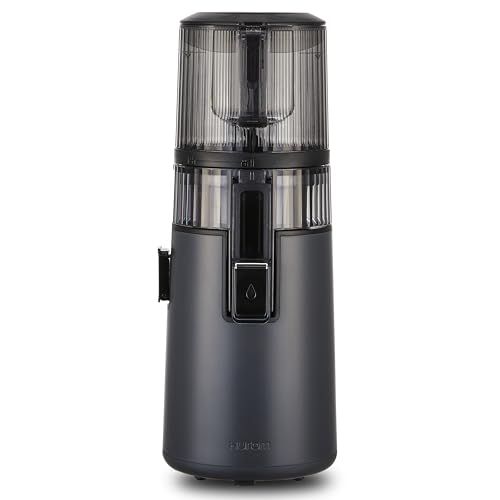
Hurom H70 Easy Clean Slow Juicer
- Best for: Solo juicers who skip sessions when cleanup looks like a chore.
- Type: Vertical slow juicer with strainer-free Easy Clean chamber
- Motor: 150 watts, AC
- Auger speed: 60/70 RPM
- Chamber capacity: 450 ml
Solo juicers who skip sessions when cleanup looks like a chore.
The 45 mm chute is the narrowest here, and the rated continuous use is up to 30 minutes per session.
The Hurom H70 answers the celery problem from the cleanup side. Its Easy Clean chamber has no fine mesh strainer to scrub, which matters because celery strings are exactly what clog those screens; the two-part auger strains as it presses, and the parts separate for a rinse. The chamber holds 450 ml, sized for a single generous glass, and the compact body takes up less counter room than the other machines here. Stalks feed through a 45 mm chute opening, so thicker celery still needs cutting into shorter pieces before it goes in.
Which One Fits Your Situation
You juice celery every morning, and little else
Choose the Omega MM900HDS. Its celery-only end cap exists for exactly this routine, pressing stalks longer than a general-purpose cap would, and the dishwasher-safe parts keep a daily habit realistic. The second cap still covers other produce when you want it, but the machine earns its counter space on celery first.
You juice for the whole household a few times a week
Choose the Nama J2. The self-feeding hopper takes a full recipe of celery, greens and fruit in one load, and the 30-fluid-ounce container holds the batch without mid-session emptying. You give up dishwasher cleaning, but you gain back the standing-and-feeding time on every batch, which is what makes a shared household routine stick week after week.
Your juices mix celery with carrots, cucumber and whole fruit
Choose the Kuvings REVO830. Long produce goes down the auto-cut chute while round fruit uses the wide chute, so one mixed recipe needs very little knife work. Its one-litre jug and stronger motor suit the bigger, varied loads this kind of juicing produces, and the two chutes mean celery never has to wait behind the apples.
Your kitchen is small and cleanup decides everything
Choose the Hurom H70. The strainer-free chamber removes the part celery strings clog worst, the body is the most compact here, and the 450 ml chamber matches a one-glass routine. Accept the narrower chute and hand washing as the trade for the quickest rinse, and for a machine that disappears into a corner afterwards.
Common Mistakes
- Buying a high-speed centrifugal juicer for daily celery, then finding the pulp still wet and the mesh basket wrapped in strings.
- Feeding full-length stalks into a narrow chute without cutting them down, which jams the auger and strains the motor.
- Using the Omega celery end cap for other fruits and vegetables, when the listing states that cap is meant for celery only.
- Ignoring the care line in the listing and discovering after purchase that every part is hand wash only.
- Loading a self-feeding hopper past its working capacity, then blaming the machine for the stall that follows.
Frequently Asked Questions
Is a slow juicer really better than a centrifugal juicer for celery?
For celery, yes, in most kitchens. A slow auger presses stalks gradually and ejects drier pulp, while a centrifugal basket shreds celery and lets the long fibres mat across the mesh, which leaves more juice behind in the pulp. Centrifugal machines are faster with hard fruit, but celery is the ingredient where the slow press shows its advantage most clearly.
How should celery be prepared before juicing?
Wash the stalks and trim the base and leafy tops. For narrow chutes, cut stalks into pieces a few inches long so they feed without bridging across the opening. Machines with an auto-cut chute or a self-feeding hopper need less cutting, but removing damaged outer stalks still helps, since they add strings without adding much juice.
Can these juicers handle celery leaves and other greens?
Yes. Every model here is a masticating or cold press design, and those handle leafy greens, kale, spinach and wheatgrass far better than spinning basket designs. Roll leaves into tight bundles or follow them with a firm stalk of celery, which pushes the greens through the auger and keeps the press working evenly.
How long does fresh celery juice keep?
Drink it the same day when you can. The Omega listing notes that juice from its low-speed press can be stored for up to 72 hours, and keeping any celery juice in a sealed, filled container in the fridge slows the flavour loss. After the first day the taste flattens noticeably, so smaller daily batches beat one big weekly batch.