Key takeaways
- Four compound digital laboratory microscopes for student lab projects, compared by magnification, camera resolution, stage design and computer connection.
Disclosure: As an Amazon Associate, we earn from qualifying purchases.
Our top pick: AmScope B120C-E1 LED Binocular Compound Microscope with USB Camera. Runner-up: SWIFT SW380T Compound Trinocular Microscope with 5.0MP Camera.
A digital laboratory microscope for student lab projects has to do more than magnify a slide. It needs to show a clear image through the eyepieces, and also send that specimen to a computer screen so a class, a lab partner, or a teacher can follow the work, save still images, and record video for a project report. The four models here are all compound laboratory microscopes with a USB camera or digital output included. Toy handheld magnifiers and coin microscopes were left out, because they lack a proper mechanical stage, a rotating objective turret, and the magnification range that prepared slides and wet mounts call for.
Each model below was checked against the research notes for this guide, and only the designated products and specifications from those notes are used here. That matters, because a base model that is merely camera compatible is not the same thing as a bundle that actually includes a camera. Where a listing describes a bundle, this guide names the bundle; where a camera is integrated into the body, this guide says so.
Quick Picks
- AmScope B120C-E1 LED Binocular Compound Microscope with USB Camera — Best overall pick: 40X-2500X magnification across six levels, a Siedentopf binocular head, LED illumination, and a 1MP USB camera included for capture to a PC.
- SWIFT SW380T Compound Trinocular Microscope with 5.0MP Camera — Best for shared viewing and recording: a trinocular head, a two-layer mechanical stage, a 5.0MP camera with Windows and Mac compatible software, and 100 blank slides included.
- OMAX MD827S30L-A183V Binocular Biological Microscope with Integrated 3MP Camera — Best for higher-resolution still images: 2000X magnification, LED illumination, and an integrated 3MP camera at 2048 by 1536 active pixels over USB 2.0.
- OMAX MD82EZ10-WM Binocular Biological Microscope with Integrated 1.3MP Camera — Best straightforward classroom option: 2500X magnification, LED illumination, and an integrated 1.3MP camera powered over USB for live streaming and capture.
AmScope B120C-E1 LED Binocular Compound Microscope with USB Camera
OUR TOP PICK
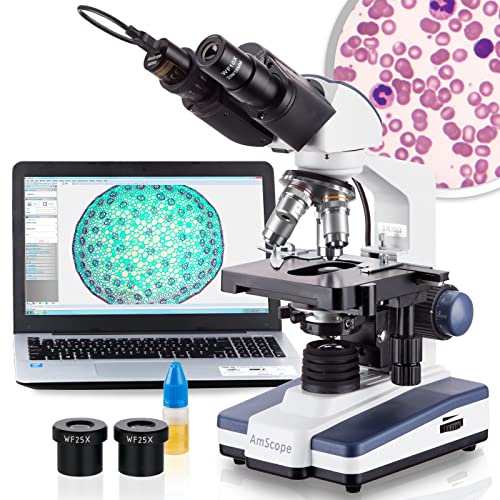
The AmScope B120C-E1 is the top pick because its listing brings together the pieces a student lab project most often needs in one package. It is a binocular compound microscope in the B120 Series, described for teaching demonstrations, clinical examinations, and laboratory applications, and aimed at teachers and students: a laboratory instrument first, with a digital camera included.
Magnification runs from 40X to 2500X across six levels. Four objective lenses sit on a rotating turret, so changing magnification means rotating the next objective into place rather than swapping parts by hand, and additional 25X eyepieces extend the maximum to 2500X. That spread lets a beginner begin low to find the specimen, centre it, and then move upward in stages instead of jumping straight to a high setting where the specimen is easy to lose.
The head is a Siedentopf binocular head, so students view with both eyes during longer sessions, and the listing describes daylight-balanced LED illumination for consistent viewing of stained specimens. It also describes a double-layer mechanical stage in related B120C-E1 listing copies, recorded here as a 3D mechanical stage design. A mechanical stage moves the slide in controlled steps, so a student can track across a specimen methodically and return to a feature instead of nudging the slide by hand and losing it.
The digital side is a USB camera included with the microscope, described in the Amazon title as a 1MP USB camera, with software for capturing images and video to a PC and for analysis: view the specimen, capture a still for a lab notebook, and record a short clip when movement matters. Some mirror copies describe this camera as 1.3MP, so the wording here follows the Amazon title, and buyers should confirm the exact figure on the live product page before ordering. Taken together, the B120C-E1 suits the widest range of student projects in this guide, from prepared slides and pond water samples to fibres and insect parts.
Specs
– Model: B120C-E1, B120 Series
– Manufacturer: United Scope LLC
– Magnification: 40X-2500X, six magnification levels
– Objectives: Four objective lenses on a rotating turret
– Eyepieces: Additional 25X eyepieces extend the maximum to 2500X
– Head: Siedentopf binocular head
– Illumination: LED, daylight-balanced
– Camera: 1MP USB camera included, as stated in the Amazon title, with software for capture and analysis on a PC
– Stage: Double-layer mechanical stage, described as a 3D mechanical stage in related listing copies
– Intended use: Teaching demonstrations, clinical examinations, and laboratory applications, for teachers and students
Pros
– Rotating four-objective turret, six magnification levels, and an included USB camera in one package
– Siedentopf binocular head suits shared benches and longer viewing sessions
– Mechanical stage helps students track across a slide in controlled steps
– LED illumination described as daylight-balanced for consistent viewing of stained specimens
Cons
– Camera resolution is modest compared with the 5.0MP and 3MP cameras on two other models in this guide
– Mirror copies give a different camera figure, so the exact camera specification needs a live check before a formal purchase
SWIFT SW380T Compound Trinocular Microscope with 5.0MP Camera
The SWIFT SW380T bundle is the runner-up when recording and sharing the image matters as much as looking through the eyepieces. The important word here is bundle. The designated product is the bundle with manufacturer part SW380T-EP5R-BSC, which includes a 5.0MP camera. The base SW380T on its own is only camera compatible, and its listing states that a camera is not included, so a project that depends on digital capture needs the bundle described here, not the base model alone.
Magnification is 40X to 2500X, matching the AmScope above, covering the progression from scanning a slide to examining fine detail. The head is a trinocular Siedentopf head, which adds a third port for the camera while the student continues to use the two eyepieces, so the person at the microscope can keep focusing normally while the camera sends the image to a computer for the rest of a group to follow.
The stage is a two-layer mechanical stage, so the slide can be positioned with dials rather than by hand, helping a group return to the same cell cluster after changing objectives.
The camera is the headline feature. It is a 5.0MP camera, the highest resolution in this guide, with software compatible with Windows and Mac for capture, livestream, and editing. Livestream support lets a teacher share the microscope image while a student operates the stage and focus, and capture and editing then preserve still images for reports and presentations. The bundle also includes 100 blank slides, so students can prepare simple wet mounts right away. Choose this bundle when the project will be shown to other people or needs clear saved images, and confirm the bundle part number before ordering.
Specs
– Model: SW380T bundle, manufacturer part SW380T-EP5R-BSC
– Magnification: 40X-2500X
– Head: Trinocular Siedentopf head
– Stage: Two-layer mechanical stage
– Camera: 5.0MP camera included in this bundle
– Software: Windows and Mac compatible software for capture, livestream, and editing
– Included supplies: 100 blank slides
– Important note: The base SW380T without this bundle is camera compatible only, and its listing states the camera is not included
Pros
– Highest camera resolution in this guide at 5.0MP, with capture, livestream, and editing software for Windows and Mac
– Trinocular head lets a student use the eyepieces while the camera feeds a computer at the same time
– Two-layer mechanical stage for controlled slide movement
– 100 blank slides included for preparing wet mounts
Cons
– The camera is included only in this specific bundle, so the bundle part number must be checked carefully when ordering
– This bundle ASIN rests on mirror copies in the research notes, so a live check of the product page is especially important before publishing or purchasing
OMAX MD827S30L-A183V Binocular Biological Microscope with Integrated 3MP Camera
The OMAX MD827S30L-A183V takes a different approach: instead of a separate camera that fits to the microscope, the 3MP camera is integrated into the biological compound microscope itself. An integrated camera keeps the setup compact, removes a separate fitting step, and makes the microscope, camera, and computer connection one system, which is easier to manage where equipment is set up and put away often.
Magnification is 2000X, lower at the top end than the 2500X of the other three models, but still covering the range students use for standard school laboratory work. A project rarely stands or falls on the final step of magnification alone; clarity at the settings actually used and a camera that records what the student sees matter more for the finished report.
The integrated camera records at 3MP, with active pixels given as 3M at 2048 by 1536, a higher still-image resolution than the AmScope camera in its Amazon title and the 1.3MP camera on the other OMAX below. Those extra pixels help when an image will be cropped, enlarged, or shown on a classroom display, and students can capture a wider scene first and select the most relevant part during write-up.
The connection is USB 2.0, used to view real-time images on a PC and to record stills and video, which also supports simple movement studies in a water sample. Illumination is LED, and with the binocular head the layout is familiar: two eyepieces, LED light, a camera that is always part of the instrument, and a single USB connection, with no separate camera unit to store or misplace between lessons. Choose this model when still-image quality is the priority and a tidy, integrated setup suits the bench better than a separate camera.
Specs
– Model: MD827S30L-A183V
– Type: Binocular biological compound microscope
– Magnification: 2000X
– Illumination: LED
– Camera: Integrated 3MP camera
– Active pixels: 3M, 2048 by 1536
– Connection: USB 2.0, to view real-time images on a PC and record stills and video
Pros
– Integrated 3MP camera at 2048 by 1536 active pixels for detailed still images
– Single USB 2.0 connection for real-time viewing, stills, and video on a PC
– Integrated design keeps the bench setup compact, with no separate camera to fit or store
– Binocular compound format with LED illumination for standard student laboratory work
Cons
– Top magnification is 2000X, below the 2500X maximum of the other models in this guide
– This ASIN and its specifications rest on the manufacturer store copy in the research notes, so a live check of the product page is especially important before publishing or purchasing
OMAX MD82EZ10-WM Binocular Biological Microscope with Integrated 1.3MP Camera
The OMAX MD82EZ10-WM is described in its manufacturer store copy as a student microscope with a built-in camera, perfect for classrooms. Like the larger OMAX above, it is a binocular biological compound microscope with the camera integrated into the instrument, so the digital function is part of the microscope from the start rather than an accessory added later.
Magnification reaches 2500X, matching the highest figure in this guide, so students can begin low to locate a specimen and work upward, using the same microscope for an introductory lesson and a more detailed project later in the term.
The integrated camera is 1.3MP, with active pixels given as 1.3M at 1280 by 1024, suited to live viewing, classroom discussion, and images for lab notebooks at ordinary document size. Students who plan to enlarge images heavily for display boards should compare it with the 3MP OMAX above and the 5.0MP SWIFT bundle, but for everyday capture it covers the central task: showing the specimen on a computer and saving what was observed.
Connectivity is USB 2.0, and the camera is powered at 5VDC over USB, keeping cabling simple at a crowded bench with no separate camera power supply. The connection streams and captures live images to a computer, turning one microscope into a shared view for a small group. Illumination is LED. Choose this model when the priority is a straightforward classroom setup with live streaming and capture, an integrated camera, and the full 2500X range, for a class that will mainly view specimens together on screen and save images at document size.
Specs
– Model: MD82EZ10-WM
– Type: Binocular biological compound microscope, described as a student microscope with a built-in camera
– Magnification: 2500X
– Illumination: LED
– Camera: Integrated 1.3MP camera
– Active pixels: 1.3M, 1280 by 1024
– Connection: USB 2.0, to stream and capture live images to a computer
– Camera power: 5VDC over USB
Pros
– Full 2500X magnification range in an integrated-camera classroom microscope
– Camera powered over USB, keeping bench cabling simple
– USB 2.0 streaming and capture for shared viewing and saved project images
– Binocular compound format with LED illumination
Cons
– Camera resolution is 1.3MP, the joint lowest in this guide, so large enlargements hold less detail than the 3MP and 5.0MP models
– This ASIN and its specifications rest on the manufacturer store copy in the research notes, so a live check of the product page is especially important before publishing or purchasing
How to Choose
Start with the camera arrangement, because it shapes daily use more than any other choice. The AmScope includes a USB camera. The SWIFT in this guide is a specific bundle that includes a 5.0MP camera, while the base SW380T alone does not include one. The two OMAX models integrate the camera into the body. Write down, before ordering, whether the exact listing includes a camera, because camera compatible and camera included lead to very different first lessons.
Next, match the head type to the way the class works. A binocular head, as on the AmScope and both OMAX models, serves one student viewing with both eyes. A trinocular head, as on the SWIFT, adds a dedicated camera port, so viewing and feeding a computer can happen together without swapping parts, which is often the most convenient layout for a teacher demonstrating to a group.
Then consider camera resolution in terms of the final project. The SWIFT bundle records at 5.0MP, the OMAX MD827S30L-A183V at 3MP, the OMAX MD82EZ10-WM at 1.3MP, and the AmScope camera is stated as 1MP in its Amazon title. Higher resolution helps with cropping, enlarging, and display work; lower resolution can still serve live viewing and ordinary lab reports well.
Look at the stage next. A mechanical stage, named for the AmScope and the SWIFT, moves a slide in controlled steps and helps students return to a feature after changing magnification, preventing the common frustration of finding an interesting area and then losing it by touching the slide by hand.
Finally, check magnification and the computer side together. Three models reach 2500X and the OMAX MD827S30L-A183V reaches 2000X, all covering standard student slides. The OMAX models use USB 2.0, with the smaller camera powered over USB; the SWIFT software is stated as compatible with Windows and Mac; the AmScope camera connects by USB to a PC. Confirm the lab computer matches the chosen model.
FAQs
What is the difference between a camera included and a camera compatible microscope?
A microscope with a camera included arrives with the camera as part of the listing, ready to connect to a computer. A camera compatible microscope can accept a camera, but the camera itself is sold separately. That distinction is central here: the SWIFT pick is the specific bundle that includes a 5.0MP camera, while the base SW380T listing states that its camera is not included.
Which camera resolution is enough for student lab projects?
It depends on the finished work. A 1MP or 1.3MP camera, as on the AmScope and the smaller OMAX, can support live viewing and images at ordinary size in a lab report. A 3MP camera holds more detail for cropping and enlarging, and a 5.0MP camera, as in the SWIFT bundle, gives the most room for display boards and presentations.
Why does a mechanical stage matter for beginners?
A mechanical stage moves the slide with dials in small, controlled steps, instead of the student pushing the slide by hand. At higher magnification, even a tiny hand movement can push the specimen out of view entirely, so a beginner with a mechanical stage can scan methodically and return to a feature after changing objectives.
Conclusion
For most student lab projects, the AmScope B120C-E1 is the top pick, with 40X-2500X magnification across six levels, four objectives on a rotating turret, a Siedentopf head, daylight-balanced LED illumination, a mechanical stage, and a USB camera included. The SWIFT SW380T bundle is the runner-up for classes that will livestream and record often, with a trinocular head, a two-layer mechanical stage, a 5.0MP camera, and 100 blank slides. The OMAX MD827S30L-A183V suits students who want an integrated 3MP camera and detailed stills, while the OMAX MD82EZ10-WM keeps the setup simplest, with an integrated 1.3MP camera powered over USB and the full 2500X range. Before ordering, confirm the exact listing includes the camera described here and that the lab computer matches the chosen model.